Pseudoasymmetric Stereogenic Unit
A stereogenic center, axis, or plane distinguished by exactly one enantiomorphic ligand pair and a reflection-invariant lowercase configuration descriptor.
Core Idea
A pseudoasymmetric stereogenic unit is a center, axis, or plane with distinguishable ligand roles, exactly one pair of which consists of nonsuperposable mirror-image, or enantiomorphic, ligands.[1] Its local configuration changes when two ligands are exchanged, but its lowercase configuration descriptor stays the same when the molecular entity is reflected in a mirror.[1] These are properties of a local unit. A molecule can contain stereogenic units without being chiral as a whole, so the classification cannot be read directly as a verdict on whole-molecule chirality.[1]
The distinction applies beyond tetrahedral carbon centers. IUPAC gives both a center marked 3r in a trithiol and an axis marked 4m in an alkylidene compound.[1] Those different geometries preserve the enantiomorphic-pair and reflection/exchange tests, while their descriptor conventions differ. Neither an ordinary chiral axis nor an arbitrary allene qualifies merely by being axial.
Structural Signature
Sig role-phrases: local stereogenic carrier — one enantiomorphic ligand pair — other distinguishable ligand roles — geometry-specific lowercase descriptor — reflection/exchange contrast.
- Local carrier. The configuration belongs to a center, axis, or plane within a molecule.[1] Removing the carrier removes the local configuration whose pseudoasymmetry is being classified. IUPAC's definition covers all three geometries.[1]
- One enantiomorphic pair. Two ligand roles are mirror-related but nonsuperposable; they remain distinguishable despite matching constitution.[1] The definition requires two and only two enantiomorphic ligands among the relevant distinguishable roles. Replace this pair by indistinguishable same-handed roles and this particular pseudoasymmetric distinction fails.[1]
- Other distinguishable roles. The remaining ligand positions complete the local arrangement.[1] Their geometry differs between a tetrahedral center and an elongated tetrahedral axial assignment; the center's diagram must not be copied onto an axis.[1]
- Ordered lowercase descriptor. A center uses r/s in preferred IUPAC names; an axial or planar pseudoasymmetric unit uses m/p.[1] The descriptor is mirror-invariant but reverses after ligand exchange.[1]
Ligand ranking follows the ordered CIP sequence rules. In the appropriate comparison, Sequence Rule 5 ranks R before its enantiomorph S; it is applied after earlier rules fail to distinguish the ligands, not as a global replacement for atomic-number and other prior comparisons.[1]
What It Is Not
-
Not the chirality of the whole molecule. A local pseudoasymmetric descriptor can be present in a molecular entity that is achiral; the unit test and the mirror-superposability test of the entire entity ask different questions.[1]
-
Not any stereogenic center with two similar branches. The relevant pair must be enantiomorphic and distinguishable in the source definition. Merely saying the branches look alike or are constitutionally similar is insufficient.[1]
-
Not every axial stereoisomer. An allene, atropisomer, or alkylidene axis can be chiral without possessing the particular enantiomorphic ligand pair that makes its unit pseudoasymmetric.
-
Not an unconditional R-over-S shortcut. CIP priority is hierarchical; the R/S comparison operates at Sequence Rule 5 when reached.[1]
-
Not evidence of a drug effect. A claim about pharmacological effectiveness needs a compound-specific causal source; pseudoasymmetric nomenclature by itself supplies no such result.
Scope of Application
The literal domain is stereochemical description of molecules containing a qualifying center, axis, or plane. The same local rule can classify a tetrahedral center in one molecule and an axial unit in another, but assigning the actual descriptor requires that geometry's configuration procedure. IUPAC illustrates the center and axis with separately named compounds in its Sequence Rule 5 examples.[1]
The boundary is structural rather than a list of molecule families. One must identify the local carrier, all relevant distinguishable ligand roles, and the enantiomorphic pair. A class label such as allene gives a possible carrier geometry, not a determination that every member has the requisite pair.
Clarity
The word chirality can obscure two levels of description. A molecular entity is chiral if it is nonsuperposable on its mirror image; a pseudoasymmetric unit is assigned a lowercase configuration descriptor that stays invariant under reflection.[1] Thus the question “Is this molecule chiral?” cannot be answered solely by spotting an r, s, m, or p local descriptor. Conversely, an achiral molecule may still require stereogenic-unit descriptors.
The lowercase notation also prevents a center-only heuristic from swallowing axes and planes. Seeing 4m in a name is a prompt to inspect an axial or planar configuration rule, not to reinterpret the unit as a tetrahedral 4r center. IUPAC's axial example also supplies 4rₐ as alternative notation for that same unit.[1]
Manages Complexity
A molecule with several stereogenic sites can generate many candidate spatial arrangements. This classification compresses one local comparison to four checks: identify the unit geometry, establish distinguishable ligand roles, test for exactly one enantiomorphic pair, then assign the appropriate lowercase descriptor through ordered CIP rules. It keeps the local configuration bookkeeping separate from the later question of whether the whole molecule is mirror-superposable.[1]
The compression does not calculate a descriptor without a structure. For an axial unit, the positions of substituents at both ends of the axis matter; a name or a claim that “R precedes S” is not a substitute for the geometry and hierarchical ligand comparison. IUPAC treats axial configuration by its own method and identifies a concrete axial pseudoasymmetric example.[1]
Abstract Reasoning
Given a proposed local unit, first draw or inspect its center, axis, or plane and enumerate the ligand positions in the correct geometry. Compare the ligands for distinguishability and find whether precisely one pair is enantiomorphic. If so, apply the configuration method and CIP priority sequence appropriate to that geometry; then ask whether reflection preserves the lowercase descriptor and an exchange reverses it. This is an inference from ligand relation and geometry to local classification and descriptor, not from a molecule-family name to a blanket label.[1]
A useful counterfactual changes only one role. If the opposed ligand pair ceases to be enantiomorphic or distinguishable, the unit no longer meets this definition. That says nothing by itself about whether another part of the molecule remains chiral. This local counterfactual repairs the frozen article's overreach from loss of one stereogenic distinction to loss of all molecular chirality.
Knowledge Transfer
The rule transfers within stereochemistry from a tetrahedral center to an axial or planar unit: the carrier geometry changes, but the requirement for one enantiomorphic pair and the reflection/exchange contrast remain. The actual descriptor procedure and symbols change with geometry. The center and axial examples below are a literal transfer across molecular architectures, not a metaphor.[1]
Outside this field, symmetry and invariance are broader ideas. They do not, without chemical ligands and CIP ranking, instantiate this named stereochemical rule. Any cross-domain analogy must be treated as an analogy rather than as another pseudoasymmetric stereogenic unit.
Examples
Canonical: a tetrahedral center in pentane-2,3,4-trithiol
IUPAC names (2R,3r,4S)-pentane-2,3,4-trithiol and assigns the lowercase 3r descriptor at C-3.[1] It determines the configurations at C-2 and C-4 first, then compares the opposed stereochemical branches for the C-3 assignment.[1] Mapped back: C-3 is the local carrier; the C-2(R) and C-4(S) paths provide the enantiomorphic comparison; its sulfanyl and hydrogen positions complete the center's ligand roles; the resulting local descriptor is lowercase r.[1] The local assignment does not itself declare the whole molecule chiral or achiral.
Applied / In Practice: an alkylidene axial unit
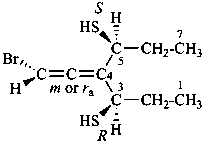
IUPAC separately names (3R,4m,5S)-4-(2-bromoethen-1-ylidene)heptane-3,5-dithiol, also giving 4rₐ as alternative axial notation.[1] Its C-3 and C-5 configurations are R and S; its C-4 pseudoasymmetric axial configuration is m under the axial method.[1] Mapped back: the C=C=C-4 axis is the local carrier; its left terminal carbon bears the distinct Br and H substituents, while the C-4 terminus bears the opposed C-5(S) and C-3(R) branches.[1] IUPAC's illustration places the C-5(S) branch above and C-3(R) below and assigns lowercase 4m. This case changes the carrier geometry while retaining the defining enantiomorphic pair and reflection/exchange rule. No additional orientation or priority conclusion is inferred from the name alone.
Structural Tensions
This category has no intrinsic two-sided tradeoff in its defining rule. Local-unit and whole-molecule chirality answer different questions; center and axis are different qualifying geometries; early and late CIP rules have a specified order. Each distinction must be resolved correctly to assign a descriptor. Treating a mistaken answer as one side of a tradeoff would obscure the classification rather than explain it.
Structural–Framed Character
Evaluative weight: the unit is a neutral structural classification; having one is neither a benefit nor a defect. Human-practice dependence: molecules and mirror relations exist independently of naming, while descriptor assignment is a human codification of the structural comparison. Institutional origin: IUPAC standardizes the nomenclature, but the enantiomorphic-ligand relation is not created by IUPAC. Vocabulary travel: invariance and exchange are broadly intelligible, yet enantiomorphic ligand, stereogenic axis, and CIP ranking fix this identity inside chemistry. Import versus recognition: a chemist recognizes qualifying molecular geometry and labels it; applying the name does not make the molecule acquire the relation.[1]
The portable skeleton is invariance under one transformation alongside change under another. A generic symmetry or asymmetry prime can express such a contrast without being a strict parent of this local chemical category. Its necessary internal Enantiomorph pair has a reviewed domain-specific parent relation, yet that pair alone does not determine the unit's CIP descriptor. The named entry remains chemically specific because the qualifying transformations act on stereogenic ligand arrangements and use the CIP descriptor system. Its character: strongly structural within stereochemistry, lightly framed by nomenclature, and domain-bound despite the wider usefulness of transformation tests.
Structural Core vs. Domain Accent
The core is one local stereogenic carrier, distinguishable ligand roles with exactly one enantiomorphic pair, and a lowercase descriptor invariant under mirror reflection but reversed by ligand exchange. The domain accents are the molecule's particular scaffold, whether its carrier is a center or axis, the selected locant, and the geometry-specific symbol and digraph. Substituting IUPAC's axial compound for its central compound preserves the rule while changing those details.[1]
The wider contrast between transformation invariance and exchange sensitivity belongs, if anywhere, to a general transformation or symmetry abstraction. It remains a possible future Prime comparison, not new cross-domain reach for this named entry. The accepted Enantiomorph parent supplies only the necessary internal mirror-related ligand pair; the operative test still requires the chemical concepts of stereogenicity, ligand geometry, and CIP ordering. The named category therefore clears the domain-specific bar without establishing a Prime identity.
Instantiates / Related Primes
This entry includes Enantiomorph.
Symmetry and Asymmetry are related broad vocabulary because mirror reflection and invariance are part of the test. Their general identities do not specify the enantiomorphic ligand pair or CIP sequence rules, so neither is asserted as a strict parent.
The live Enantiomorph entry supplies the internal pair of nonsuperposable mirror-related ligand forms that every qualifying unit contains. This is a strict composition/part_of edge, directed from this unit to the pair relation as the internal constituent; the unit is not a subtype of an enantiomorph. The live Stereoisomer entry addresses spatially different molecular species with fixed constitution; this entry classifies a local carrier and its descriptor, not a whole species. The live Cis–Trans Isomerism entry concerns a different relative-position relation. Neither is made a taxonomic parent by shared terminology.
Relationships to Other Abstractions
Current abstraction Pseudoasymmetric Stereogenic Unit Domain-specific
Parents (1) — outgoing typed relations
-
Pseudoasymmetric Stereogenic Unit includes Enantiomorph Domain-specific
Every pseudoasymmetric stereogenic unit contains exactly one identity-bearing pair of enantiomorphic ligands.The candidate's defining local center, axis, or plane contains a pair of distinguishable ligand forms that are nonsuperposable mirror images. The live Enantiomorph entry names that pair relation under the allowed direct motions of its setting. Removing the pair destroys the candidate's pseudoasymmetric differentia. Enantiomorphic pairs occur independently, including in geometric forms lacking any chemical stereogenic unit. The parent relation is internal to the ligand structure, not a molecular stereoisomer species or a taxonomic genus of local units.
Condition / exception Chemical three-dimensional ligand comparison; ordinary axial chirality without an enantiomorphic ligand pair is excluded.
Hierarchy path (1) — routes to 1 parentless root
- Pseudoasymmetric Stereogenic Unit → includes Enantiomorph
Neighborhood in Abstraction Space
Pseudoasymmetric Stereogenic Unit sits in a sparse region of the domain-specific corpus (72nd percentile for distinctiveness): few abstractions share its structure, so a faithful description tends to retrieve it precisely.
Family — Unclustered & Miscellaneous (2769 abstractions)
Nearest neighbors
- Stereoisomer — 0.85
- Symmetry of diatomic molecules — 0.83
- Conjugated System — 0.83
- Octahedral Molecular Geometry — 0.83
- Membrane Curvature — 0.83
Computed from structural-signature embeddings · 2026-10-25
Not to Be Confused With
Pseudo-asymmetric carbon atom is a traditional name for the tetrahedral carbon-center case; IUPAC's broader stereogenic-unit definition also includes qualifying axes and planes.[2][1] Ordinary chirality centers and axes can carry uppercase reflection-changing assignments without this precisely one-pair pseudoasymmetric condition. A meso or achiral molecule is a whole-entity classification, not the name of each local unit inside it.[1]
References
[1] IUPAC. (2013). Nomenclature of Organic Chemistry IUPAC Recommendations and Preferred Names 2013, Chapter P-9. P-92.1.1(d) defines pseudoasymmetric stereogenic centers, axes and planes and the reflection/exchange rule; P-92.1.3.5 and P-92.6 specify ordered Sequence Rule 5 and r/s versus m/p usage; P-92.6 Examples 1 and 3 provide the two named molecular realizations. This is the same 2013 work already cited by the live Cis–Trans Isomerism entry. registry ↩a ↩b ↩c ↩d ↩e ↩f ↩g ↩h ↩i ↩j ↩k ↩l ↩m ↩n ↩o ↩p ↩q ↩r ↩s ↩t ↩u ↩v ↩w ↩x ↩y ↩z ↩27 ↩28 ↩29 ↩30 ↩31 ↩32 ↩33
[2] IUPAC Commission on Nomenclature of Organic Chemistry (1996), Basic Terminology of Stereochemistry (IUPAC Recommendations 1996), Pure and Applied Chemistry 68, 2193–2222. The first-party “Pseudo-asymmetric Carbon Atom” entry calls the tetrahedrally coordinated carbon atom a traditional term and specifies its enantiomorphic pair and mirror-invariant r/s descriptor. This is the same 1996 work already cited by the live Cis–Trans Isomerism entry; the link points to its directly inspected N–Q section. registry ↩