A guided tour
Six stops, about ten minutes. Each shows one part of the encyclopedia in a picture, says how to read it, and ends with a button that opens the real page.
1. A prime abstraction: Feedback
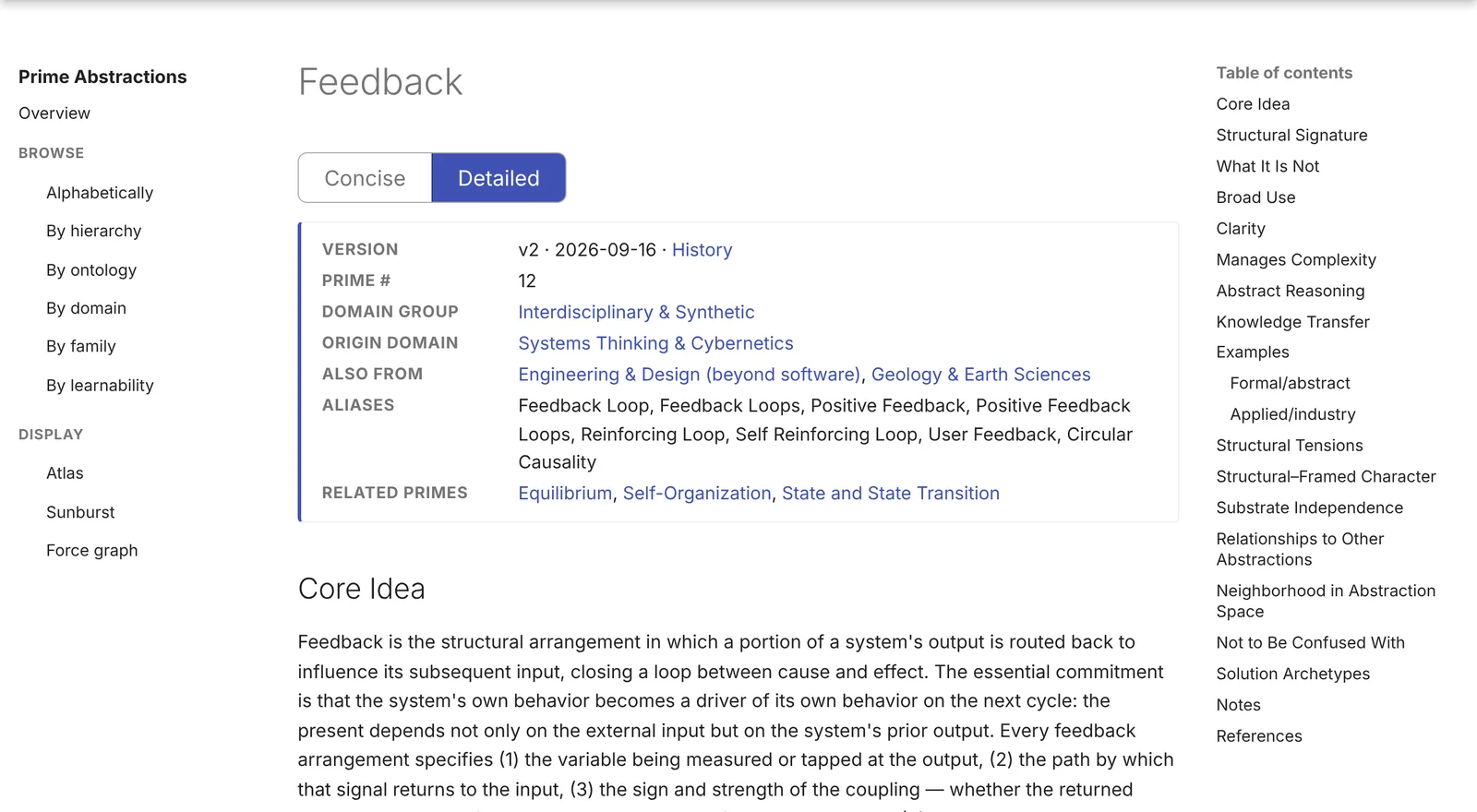
A prime abstraction is a pattern that recurs across at least three unrelated fields; Feedback is one of 1,524. Every prime page has the same order. The Core Idea says what the pattern is, the Structural Signature lists the parts that must be present, What It Is Not rules out near misses, the Examples show it in formal and applied settings, and the Structural Tensions say where it strains or fails. Switch to Concise for the short version, or use the reading-level buttons under the Core Idea for a plainer explanation.
2. A domain-specific instance: Filter bubble
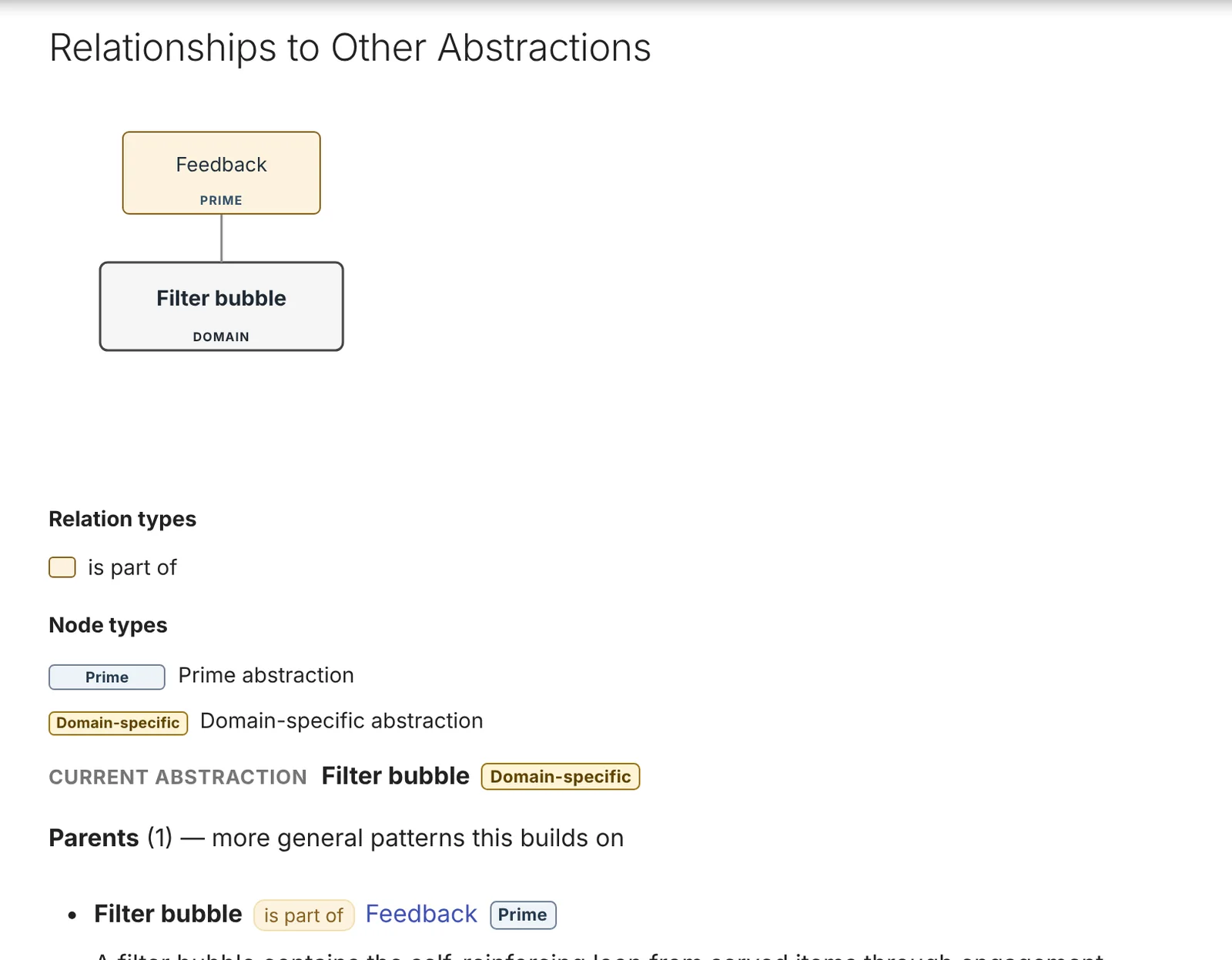
A domain-specific abstraction is a pattern bound to one field. Feedback has 168 entries directly beneath it (46 primes and 122 domain-specific), and Filter bubble is the one most people have met: a recommender learns from what you click, shows you more of it, and learns again. Its Relationships to Other Abstractions section names Feedback as its parent and says why, and Structural Core vs. Domain Accent separates what it shares with Feedback from what belongs only to recommender systems. That split is what makes transfer possible: whatever acts on the shared loop is worth trying wherever the same loop appears. For the case closest to a thermostat, see Demand-controlled ventilation.
3. A solution archetype: Counterexample search
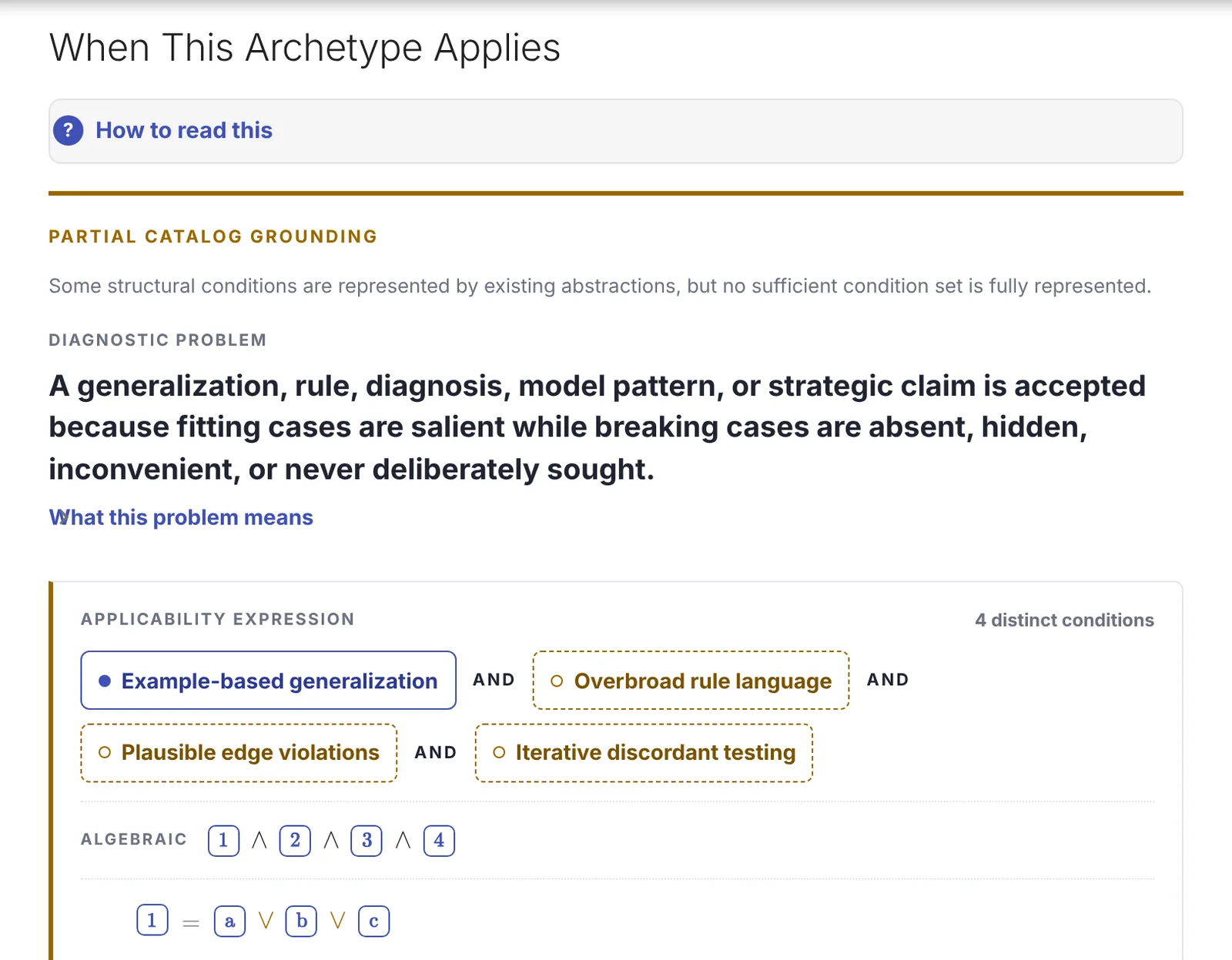
Primes and domain-specific entries describe situations; a solution archetype is a recurring way of acting on one. Its page opens with When This Archetype Applies, which says in plain logic when it fits. Conditions joined by and must all hold, and where there are alternatives, any one of them completes the pattern. Each condition is grounded when an entry in this encyclopedia captures it, and open when none does yet. The entries that ground it are listed under it as a, b, c.
Counterexample search has four conditions, all required, and one of the four is grounded. The entries that ground it are HARKing (Hypothesizing After the Results are Known), Cherry Picking and Spotlight Fallacy. So this page shows open conditions more than groundings. An open condition is not a weak one: it marks a place where the catalog has not yet found a matching abstraction. Every archetype page explains this under How to read this section, just above the block, with a link to the methodology.
Open Counterexample search → Read the methodology
4. The Atlas
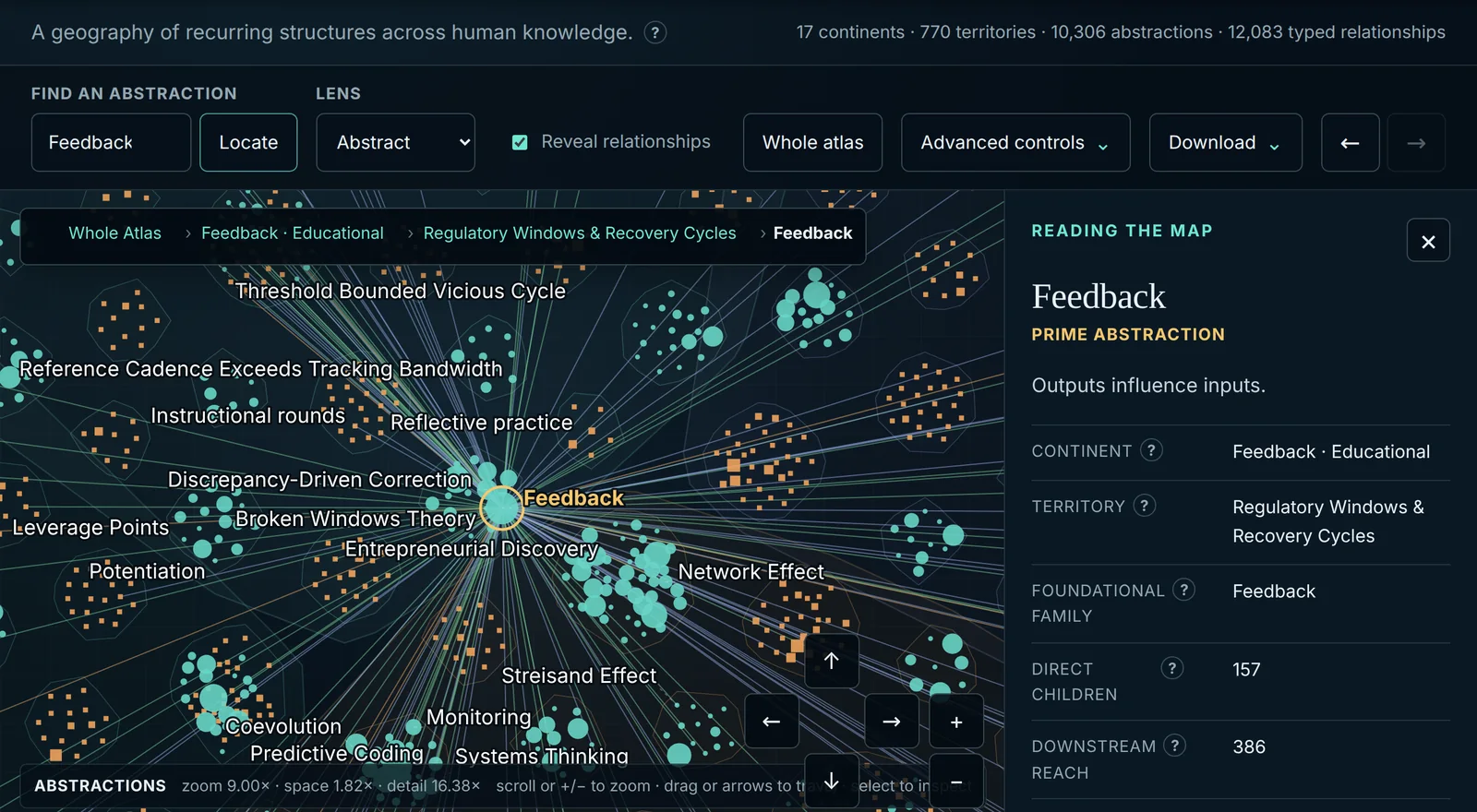
The Atlas is a map of the abstractions in the hierarchy. From far away you see continents; zoom in and they break into named territories, then into single entries, circles for primes and squares for domain-specific ones, joined by their relationships. Type a name under Find an abstraction and press Locate to fly to it, and use the Lens menu to recolour the map. Select an entry to see its relationships in the panel on the right; Why? beside one shows the sentence that justifies it.
5. The Shape of the Abstraction Space
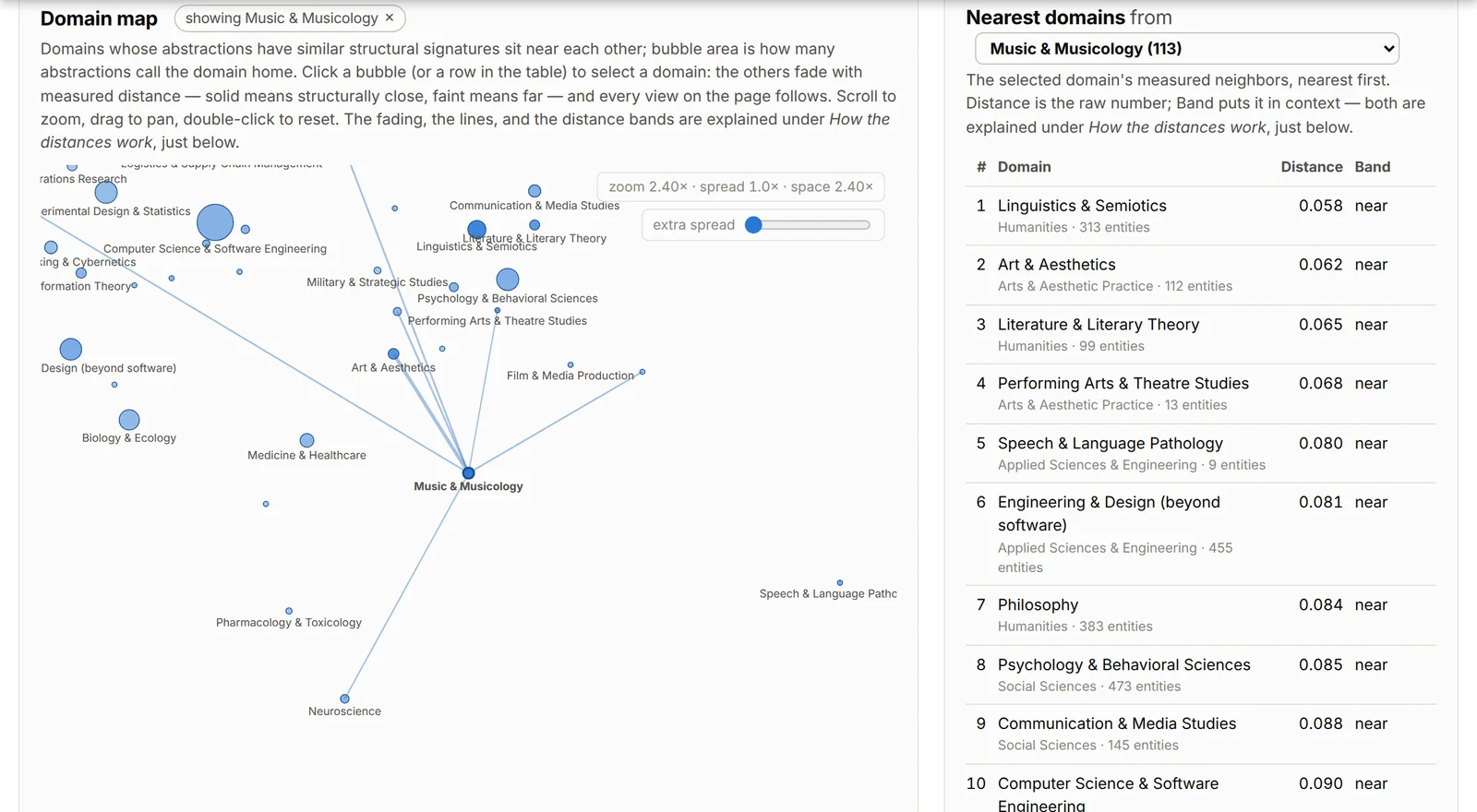
The Shape page steps back further. Each field of knowledge is one bubble, sized by how many abstractions come from it and placed by how similar their structures are. Select a field and the others fade with distance, solid for near and faint for far, while the table lists its nearest neighbours. Try Music & Musicology and see which fields come out nearest: distance here is measured on the structure of the abstractions, not on the subject. How the distances work, further down the page, explains the measure.